Managing the Alcohol-Anxiety Loop

Updated: Oct 8
Prefer to listen instead? Click here for Upskilled Podcast
One problem I’m often asked to help solve is how to break the cycle of drinking due to social anxiety. To understand how to do that, you must first recognize it’s even happening. My clients usually struggle with social anxiety that leads to drinking at the end of the evening or drinking to ward off anxiety in a social setting (sometimes both), then paying for it later. Relief-seeking isn’t a problem so much as assuming the alcohol is “relief” you seek.
What type of anxiety have I seen the most in my career? Social Anxiety, and our over-reliance on technology has not helped, especially since the pandemic.
Social Anxiety Disorder (SAD) (formerly called social phobia) is intense fear of social or performance situations such as dating, or public speaking. It can present itself like worry that your feelings and behaviors will be judged negatively by others or have an intense fear. Anxiety Disorders - National Institute of Mental Health (NIMH).
Anxiety and drinking are connected in a way that most high performers never stop to examine. You just know the pattern works, at least for a little while. Understanding why it works, and why it eventually stops working, is the first step toward changing it.

Alcohol Turns Down the Volume, Fast
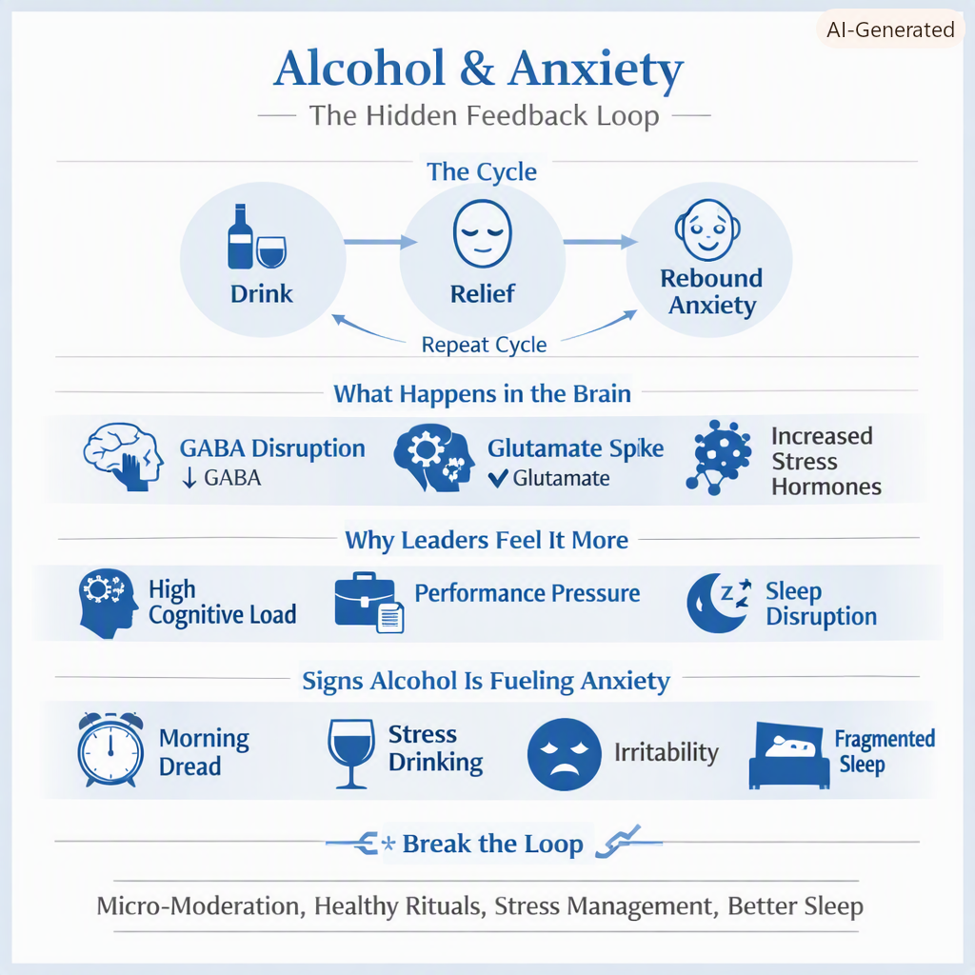
Anxiety is your nervous system running hot. Your brain is scanning for threats, replaying conversations, and bracing for what could go wrong next. Alcohol slows that system down. It boosts a calming brain chemical called GABA and dampens a stimulating one called glutamate Gamma-Aminobutyric Acid (GABA): What It Is, Function & Benefits. The result is quick and noticeable.
Most clients report getting off work being a trigger which causes a physiological response before they even take a sip. Once you actually start to drink, your thoughts slow down, and your body loosens up.
Your Brain Learns the Shortcut
Here is where the pattern locks in. Every time a drink calms you down, your brain files that away as useful information. Stressful day, drink, relief. Repeat that enough times and it stops being a choice. It becomes a reflex, as shown in this infographic.
If you already use alcohol to manage social anxiety, these moments stack the pattern even higher. You are not just drinking to unwind. You are drinking to perform ease you do not actually feel. Over time, that gap between how you look and how you actually feel starts to cost you energy you do not have to spare.

Breaking The Loop Starts with Seeing It
You cannot outthink a pattern you have not named. The first move is simply noticing when the urge to drink shows up and what it is actually responding to. Is it the meeting that went sideways? The dinner where you had to perform confidence you did not feel? The blank hour at the end of the day when your mind finally has room to race?
Once you can name the trigger, you can build a different response, one that actually addresses the anxiety instead of muting it for a few hours and handing you a bigger bill tomorrow.
This is where my Cut, Rewire, Activate, Maintain (CRAM) framework comes in.
Cut
Interrupt the automatic loop so the reflex stops running the show. Things that have worked for my clients are a quiet pause and reflection, just for a minute or two. Also, a splash of cold water on your face to wake your senses once you’re home, but before reaching for a drink.
Rewire
Shift the stress and reward pathways so calm comes from you and not a drink. Understand what needs rewiring. Is it anxiety from daily stress, work, social or other settings? I’ve helped hundreds of clients build a transition plan for leaving work and coming home. Plans are also necessary for approaching social situations. Having a plan is half of the battle when faced with anxiety and/or drinking.
Activate
Practice the new wiring in real moments: client dinners, late nights, social pressure. For example, adding regular, gentle workouts that don’t cause stress, such as Thai Chi, or Yoga. Regular cardio and strength training cause stress on the body (in a good way!). These gentler movements are an excellent way to regulate your nervous system, and to build in some calming meditation-like focus.
Maintain
Build durability so the change holds when life gets hard again. Maintaining positive habits can be difficult at first, so give yourself some grace and self-compassion as you develop new ways of living.
This is not “white knuckling” anything, this is conditioning.

If you’d like to learn more, check out Mindful Drinking Skills for the Anxious Leader, a 90-day course that comes with office hours, and monthly group coaching. You'll move from using alcohol to manage social anxiety, overwhelm, and stress, to having a healthier relationship with alcohol in 90 days!
If you’re a leader on a wellness journey that doesn’t involved alcohol, I’d love to hear from you: info@skilledconcepts.com.
Vanessa is an Alcohol Coach with over 20 years of experience working in behavioral health and addictions as a clinician and clinical supervisor. She built Skilled Concepts, LLC to educate and inform high-performing leaders who want to change their relationship with alcohol and prevent burnout. She offers asynchronous coaching with ongoing skill building, rapid feedback, and personalized support-all without waiting for a scheduled session. Vanessa subscribes to alternative methods of changing habits including moderation, mindful drinking, and complete abstinence.

Other ways to connect:

